
Route a Princeton Address Through County Records
No single database answers every question about a Princeton parcel. A productive search moves between county and city sources. Start at the Caldwell County PVA, whose parcel report gives you the Current Owner field, map and account number, class, assessed values, and the deed book and page. Split that deed reference from the rest. From there, carry it to the Caldwell County Clerk. The sheriff handles the tax bill. City offices matter only for municipal land-use or enforcement questions.
- Search the Princeton situs address, owner, or exact parcel number in qPublic/Beacon.
- Confirm the street and map/account number on the selected PVA card.
- Carry the deed book/page into the Clerk's deed records.
- Check the sheriff's bill separately for collection status and its January 1 owner snapshot.
- Ask Princeton City Hall for the applicable planning, permit, zoning, or code file.
The countywide property search walkthrough covers the portal mechanics in detail. Princeton's own geography and its municipal offices supply the city-level context that guide leaves out.
The Two Desks Behind Princeton Property Records
Two desks stand behind every Princeton parcel. County custodians hold the title, assessment and collection evidence. Princeton itself adds the local development and compliance layer. For an older downtown building, that split matters: a city permit may explain past alterations, but only the recorded deed shows the actual conveyance.
Caldwell County land and tax records
The PVA reports parcels and assessments; the Clerk records deeds, mortgages, liens, plats and releases; the sheriff collects property tax.
Princeton permits and zoning
206 East Market Street
Princeton, KY 42445
270-365-9575
City Hall keeps weekday hours of 8:00 a.m. to 4:30 p.m., Monday through Friday. The city publishes no summary of how far back its permit files reach or how long it retains them. Describe the property you care about and ask staff what exists today.
Princeton's County-Seat Record Geography
The official 2020 incorporated-place table counts 6,270 Princeton residents. That figure makes Princeton Caldwell County's largest incorporated place. It is also the county seat. The courthouse, the library and City Hall therefore sit close together. Proximity does not merge their responsibilities, though.
The Clerk sits at 100 East Market Street and holds the land instruments. City Hall, at 206 East Market, keeps the planning material. George Coon Public Library, at 201 West Main, holds local-history clues. Keep each fact tied to its source. A newspaper can name a former occupant, but only a recorded deed establishes the conveyance trail.
Princeton Record Areas, Districts, and Landmarks
The city publishes no complete official roster of subdivisions. For Princeton property records, the defensible approach leans on named historic districts, landmark corridors and documented parcels rather than invented neighborhood names.
| Documented area | Record clue | Best next source |
|---|---|---|
| Princeton Downtown Commercial District | Historic lot-and-block core and street-frontage descriptions | National Register material, plats and deeds |
| Big Spring / East Washington | Big Spring at 111 East Washington Street | NPS landmark record, PVA and Clerk |
| South Jefferson corridor | L.B. Overby House and other named historic properties | Nomination records and deed chain |
| Hawthorne and Harrison examples | P10-3-14, P6-5-21 and P4-29-8 | PVA map key and cited deed book/page |
Adsmore, Champion-Shepherdson House, Flournoy-Henry House, Powell House and Knott House work as property-history anchors. They are landmarks, not modern subdivisions. Use the Caldwell parcel map guide to turn a geographic clue into the responsible record.
Read Downtown Princeton Lots Beyond the Street Number
The Princeton Downtown Commercial District record supplies architectural and district context for commercial-core addresses. Older deeds often describe parcels differently, by lot and block, adjoining owners or street frontage. A modern address search can miss that wording entirely.
Start with the modern parcel card and copy its deed reference. Read the legal description. Find the cited plat when one exists. Then work backward through grantor and grantee entries. The district record orients you to buildings and streets. It decides nothing about ownership, boundaries, exemptions or current value.
Big Spring Connects Washington Street to History
The National Park Service Big Spring page locates this Trail of Tears and National Register landmark at 111 East Washington Street. The public address is stable. It helps tie a familiar site to parcel, deed and municipal records. Older descriptions sometimes use different geographic language.
For landmark-related Princeton property records, pair the PVA card and deed chain with National Register documentation. Add city planning files too. Historic importance never creates a tax exemption. It fixes no parcel line and imposes no covenant. Search the Clerk for the restrictions, easements and transfers actually recorded against the parcel.
Follow the P10-3-14 Hawthorne Trail
A June 2025 public surplus notice names 310 Hawthorne Street. It lists map P10-3-14 and deed 108/24. That compact citation shows a powerful Princeton workflow. It runs address, then PVA parcel key, then Clerk book and page. Similar notices cite P6-5-21 at 530 South Harrison and P4-29-8 at 400 North Harrison.
Other Caldwell identifiers include 93-11A, 41-11 and 94-13F. More examples are 3-11, 7-22 and 31A-17. The county publishes no formal grammar for every segment. Preserve prefixes, hyphens and suffix letters exactly as written. If a parcel search rejects one version, fall back to street or owner. Then compare the deed reference that returns.
Note: A public-notice example teaches the search method but does not establish a parcel's present owner, availability, or condition.
Choose the Right Princeton PZ Form
The city's planning and zoning forms page is a PDF index, not an address-searchable permit database. It lists nine named PZ documents. The city publishes no fee table, historic coverage, export feature, pagination or searchable filing inventory alongside them.
| Form | Municipal action | When it may matter |
|---|---|---|
| PZ-1 | Building Permit | Proposed construction |
| PZ-2 | Improvement Location Permit | Siting an improvement |
| PZ-3 | Conditional Use | Use requiring special approval |
| PZ-4 | Dimensional Variance | Relief from dimensional rules |
| PZ-5 | Map Amendment | Requested zoning-map change |
| PZ-6 | Text Amendment | Requested zoning-text change |
| PZ-7 | Sign Permit | Ordinary regulated sign |
| PZ-8 | Sign Permit over 250 square feet | Large-sign proposal |
| PZ-9 | Billboard Permit | Billboard proposal |
The screenshot below comes from the official Princeton planning forms index.
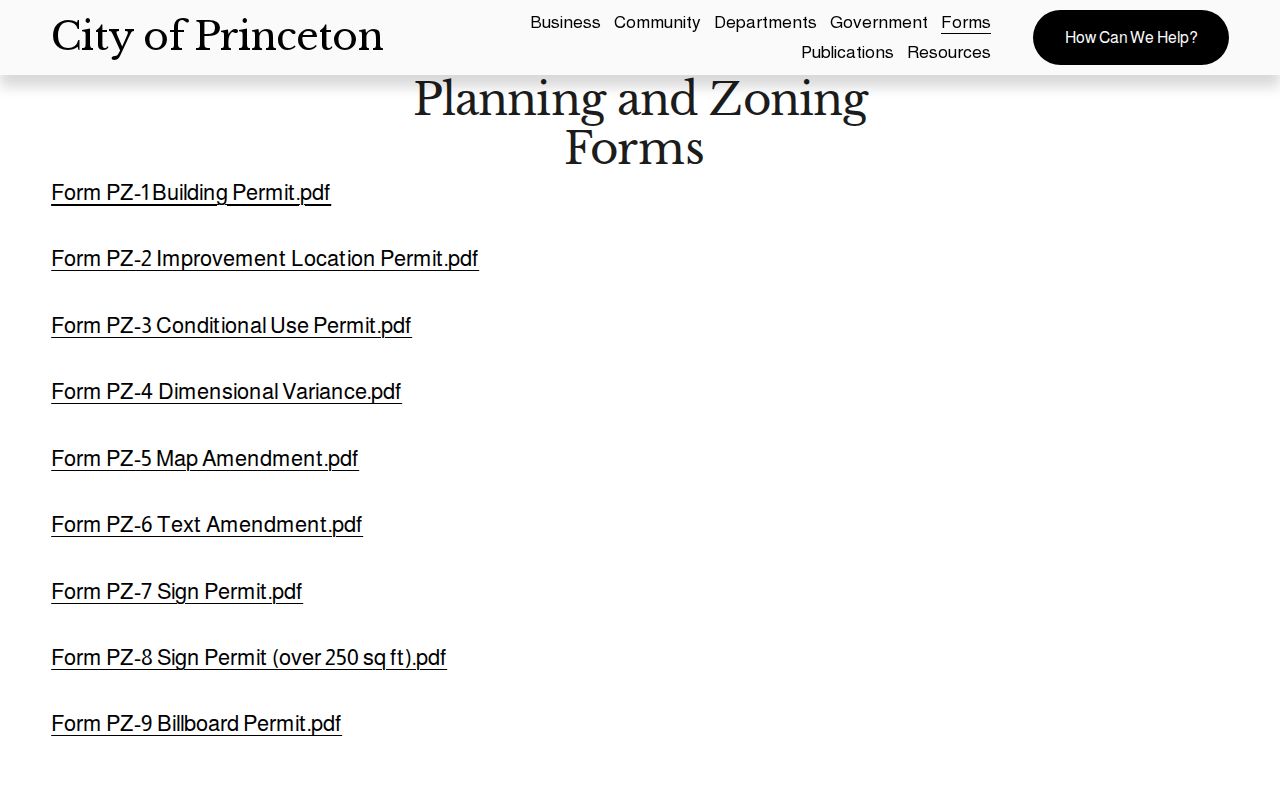
The municipal forms route is the right one for permit paperwork. Ask City Hall for an address-specific file, since the index exposes no individual permit records.
Request Princeton Code and Condemnation Files
Code cases and condemnation records live with the city, not the county deed books. The Princeton Code Enforcement page offers an online complaint form. It also names the Code Enforcement Board. The page links both active and inactive condemnation information. Kentucky's KRS 65.8801–65.8839 statutes supply the framework the city cites for these procedures.
Keep the limits clear. A complaint or condemnation entry tracks municipal enforcement. It cannot prove deed ownership or stand in for an inspection. Ask City Hall for the property's public file and its dates. Then match the street address to the county parcel number before drawing conclusions. If the document is not posted, a narrow Kentucky Open Records Act request naming the property will usually move things along. Name the records you need in that request.
Princeton 42445 Is Not a Boundary Map
ZIP 42445 is the common Princeton mailing code, yet mail routes and city limits do not match. A rural parcel can carry a Princeton address while sitting beyond the incorporated boundary, and land near an edge may fall under county planning instead of city oversight. The USPS ZIP Code Lookup confirms delivery data only. It proves nothing about jurisdiction.
No complete annexation timeline exists in official sources, so treat any specific annexation year with caution. Verify the situs with Caldwell County 911 Addressing. Pull the tax parcel from the PVA. Then ask the city directly whether the property sits inside its planning or code authority.
George Coon Adds a Princeton History Layer
The George Coon Public Library genealogy center at 201 West Main holds local newspapers and obituaries. It also keeps family files, yearbooks, and deed and marriage material. The Glenn E. Martin room kept Monday-through-Saturday hours of 10 a.m. to 3 p.m. Call ahead to confirm before a visit.
These collections shine where official indexes fall short. An estate suffix, a name change, a former business occupant, or a landmark address often becomes clear in a newspaper or family file. Such clues may span the decades. Pair each clue with the PVA and the Clerk, though. A directory entry or obituary is a lead, not title evidence. The library is a valuable fallback when online deed depth runs thin. It also helps when an old address refuses to match the modern situs.
Understand Princeton Property Record Limits
Princeton property records can identify the tax-roll owner, assessed characteristics, recorded deeds and liens, parcel reference, tax status, municipal applications and code actions. They cannot alone certify marketable title, locate a surveyed corner, guarantee a building's condition, establish occupancy, or provide a current market appraisal. The latest deed can be newer than a tax bill whose owner was fixed as of January 1.
Lawful use. Use Princeton property records for purchases, boundary and easement research, assessment review, property history, estate questions and civic transparency; never use personal information to stalk, harass or harm anyone.
Verify critical facts with the custodian who owns them. The Clerk handles deed copies and recorded interests. The PVA corrects assessments. The sheriff collects taxes. Princeton City Hall answers for zoning, permits, and enforcement. Going source by source keeps a useful public clue from masquerading as a legal conclusion.
When you assemble a final Princeton comparison, keep municipal and county facts in separate columns. Note whether the situs lies inside the city. Note which PVA tax district applies, which planning form governs the work, and which deed reference controls the land description. Remember that ZIP 42445 is a mailing clue, not boundary proof. For a downtown or landmark property, list the historic resource name and period beside the current parcel class and building facts. Never treat designation as a valuation formula. At a rural-edge address, confirm the E911 situs and map identity before requesting city documents. This discipline stops a permit file, nomination, assessment, or deed from answering a question outside its purpose. It also leaves a dated trail when addresses, parcel configurations, or assessments change.