
Read Caldwell County's Owner-of-Record Card
The Caldwell County PVA landing page routes parcel searches into the current Beacon system. Its report labels the key identity field Current Owner. That name is a starting point, so read it beside the parcel's other fields instead of treating it as a settled fact.
| Current Owner | The person, joint parties, estate, trust, or entity carried on the assessment record. |
|---|---|
| Owner address | The destination for assessment correspondence; it may be outside Caldwell County. |
| Location address | The situs of the parcel, not proof that the named owner occupies it. |
| Sale date and price | A transfer clue subject to the PVA's accuracy and qualification cautions. |
| Deed reference | The book/page or related reference used to cross-check the Clerk's land records. |
| Last data upload | The timestamp showing when the displayed roll snapshot was loaded. |
A local sample card shows why context matters, listing map, account, and PID identifiers, class, homestead status, tax district, rate, deed reference, and an exact last-upload timestamp. Those fields pin down the parcel and measure freshness. The owner address is for correspondence. The situs is the land. Neither proves occupancy, and the PVA search-information page posts the official Caldwell entry point along with its accuracy warning.
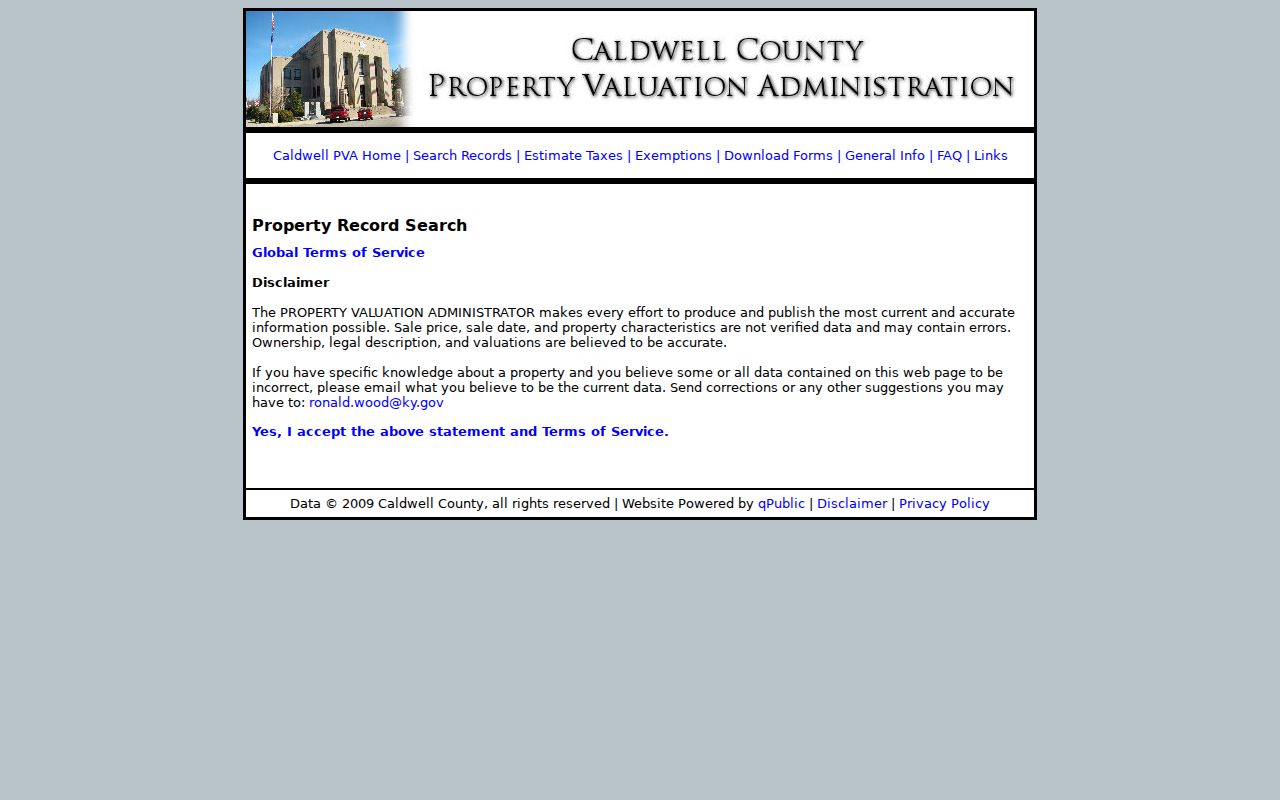
This PVA landing page is only a doorway. Treat it as a route into the live parcel record, not a current-owner result, and note the upload date the live record displays.
The Caldwell Certified-Roll Snapshot Has a Date
The PVA explains that its web material reflects the certified tax roll and may not include later changes. That limitation is especially important when checking a current owner just after a closing. The Caldwell County Sheriff tax search adds a second date rule: a bill names the owner as of January 1 of the tax year, and the Sheriff does not immediately receive every transfer.
Consequently, a bill can accurately preserve the January 1 taxpayer while a newer recorded deed identifies today's grantee. The two screens are describing different snapshots, not necessarily contradicting each other. Note the tax year, PVA upload, sale date, and deed recording date before deciding which record answers a present-tense question.
Note: The January 1 name on a tax bill can remain unchanged after a later closing in the same year.
Use Upload and Recording Dates to Test Freshness
One sample shows the trick. Its "Last Data Upload: 4/10/2024, 9:00:29 AM" line is the key detail. Record that timestamp. Then weigh it against the sale date and the Clerk's recording date. A later-recorded deed cannot appear on that card. An older deed with conflicting names is a fair question for the PVA or Clerk about indexing and assessment status.
Recent-sale gap. The roll can lag a transfer; for a present owner, the newest recorded deed is the more current evidence, though neither is a title opinion.
A parcel card packs in the map/account/PID, district, homestead indicator, class, fair cash value, deed reference, sales history, and the Last Data Upload line. Together they test two things at once. Is this the right parcel? Is the data fresh? A matching street name alone is weak evidence once rural routes, mailing cities, and similar addresses blur the picture, so copy the parcel identifier and deed book/page before leaving the card. Three dates answer three questions. The deed date records execution. The recording date shows when the Clerk accepted the instrument. The upload timestamp marks when the assessment snapshot loaded; sale-date fields add context, but the PVA cautions that sale information may require correction and is not the controlling conveyance evidence. If the PVA still names the seller, search the Clerk under both seller and buyer spellings. A newer deed matching the parcel settles it. Keep that reference. Ask the PVA about its update cycle. When no matching deed appears, do not assume a closing announcement, a change of possession, a contract, or a tax payment completed the public transfer. Local formatting rewards literal eyes. A joint owner may appear as CORTNER JERRY K & MARGERY. An estate may show as WOOD GARLAND EST. Preserve ampersands, initials, suffixes, and entity designators exactly, and search the exact roll version before trying careful variants. Never infer a family relationship the record does not state.
Separate Caldwell Owner Mail From the Property Address
Mailing and location addresses answer different questions. A farm can carry one. So can a vacant lot, an inherited house, a commercial parcel, or an entity-owned building, with tax mail sent wherever the owner directs. Search the situs to identify the land, then use the owner line and mailing address exactly as displayed, since a ZIP like Princeton 42445, Dawson Springs 42408, or Fredonia 42411 reflects postal geography rather than municipal limits. ZIP codes are postal geography. Parcel and city boundaries come from government records instead. Caldwell County 911 Addressing assigns addresses for new structures. That administrative address aids emergency response and parcel matching, but it conveys no ownership. When spellings or road forms differ, keep the map number as the stable bridge between the situs, the assessment card, and the deed reference.
Confirm Caldwell County's Current Owner at the Clerk
The Caldwell County Clerk's Deeds & Records page points to eCCLIX and describes up to five free citizen searches each day. The live account page shows a conflicting zero-search limit. Check the current terms. Confirmation is narrow. Match the PVA parcel and deed reference to the most recent conveyance, then read the grantee exactly.
- Open the PVA/Beacon parcel reached by address, owner, or map number; copy the Current Owner, map number, deed reference, and upload date.
- Search the current owner's name as grantee in eCCLIX and identify the latest deed tied to the matching legal description or book/page.
- Compare recording date and grantee with the PVA snapshot. For an LLC, check the official Kentucky business profile without substituting an agent for the titled entity.
- If online access fails, call or visit the Clerk at 100 East Market Street, Room 23, Princeton, 270-365-6754, or submit a focused open-records request.
- Owner of record
- The party carried as owner in the relevant public record.
- Assessment roll
- The PVA's property inventory and valuation record for taxation.
- Situs
- The physical location of the parcel, distinct from the owner's mailing destination.
- Recording lag
- The interval between recording a transfer and its appearance in a later assessment or bill snapshot.
Check Trust, Estate, and LLC Names Literally
Exact spelling decides whether a deed search succeeds. Caldwell County entries like “CORTNER JERRY K & MARGERY” and “WOOD GARLAND EST.” show how punctuation, initials, suffixes, and joint-owner formatting shape what the Clerk's index displays. Preserve the displayed version first. Then try reasonable variants in the index. An estate can stay cloudy until a probate file, affidavit of descent, commissioner deed, or later conveyance clarifies who owns the property. Entity owners call for a different tool. The Secretary of State Business Search confirms a Kentucky entity's official spelling, status, filings, registered agent, and principal-office information. That profile names the organization; it does not transfer the land, and a registered agent is not automatically the owner of record.
Monitor New Caldwell Deeds With DOC ALERT
DOC ALERT offers a free heads-up. The Clerk's current records page links this notification service, which emails you when a deed or mortgage is recorded under a subscribed personal or business name. It works best as an early-warning layer. Confirm the current owner of record first. The county page publishes no launch date and does not promise every identity variation will match. Treat an alert as a prompt only. It is not proof of fraud or clean title. A common name can trigger an unrelated notice, while a different spelling can slip past a match entirely. Verify the document independently with the Clerk, and if an instrument looks suspicious, contact a lender or law-enforcement office through a published number.
Use Caldwell County Owner Information Lawfully
A Caldwell County tax-roll mailing address has limits. It can support one restrained property-related letter. But it is not an invitation to repeated unwanted contact. Kentucky Safe at Home gives eligible survivors a substitute address. The program's compliance guidance excludes real-estate holdings from shielding. So never assume a participant's deed or parcel vanishes. Sensitive identifiers inside document images should never be republished.
Lawful use. Public access does not authorize stalking, harassment, threats, surveillance, or publication of protected data. Kentucky's KRS 508.140 and KRS 525.070 set criminal boundaries.