
What Caldwell County Property Tax Records Reveal
Every Caldwell County property tax question really has two halves. The PVA keeps the assessment side. It sets fair cash value and records property characteristics on the parcel card. The sheriff handles the collection side. That office takes the certified roll and turns it into the actual tax bill. Confusing the two is the classic mistake. A paid bill, an appraisal, and a sale price are three different numbers. Treating them as one leads property owners astray fast.
| Field | What It Shows | Where |
|---|---|---|
| Land and improvement value | The PVA's component assessments and total value | Caldwell County PVA parcel card |
| Fair cash value | Kentucky's ordinary real-property assessment level | PVA and Kentucky Revenue guidance |
| Class and exemptions | Property classification, homestead status, and agricultural-use treatment | PVA parcel card and forms |
| Tax bill and status | Amount charged, collection period, payment, or delinquency | Caldwell County Sheriff |
| Owner date | The tax-bill owner as of January 1 of that tax year | Sheriff search guidance |
A recorded sale price proves what changed hands in a transaction. The assessed value is something else entirely: the PVA's valuation for administering property tax. Exemptions and agricultural-use treatment can move the taxable figure. They do not touch the arm's-length sale behind it. For a closer look at how these values work, see the Caldwell County property value guide.
Read the Caldwell PVA Parcel Card
The Caldwell PVA search information page leads into the current SchneiderCorp system. It notes that the online data serves public convenience rather than replacing the certified roll. A typical parcel card shows map and account numbers. It also lists the tax district, current owner, and deed book and page. Fair cash values, tax rate, class, and a homestead indicator appear as well. Sale history and a building sketch are included too. Look for the last-data-upload timestamp before relying on any figure.
| Card field | How to use it |
|---|---|
| Map / account / PID | Carry the parcel identifier into the map, clerk, or tax-bill workflow. |
| Current Owner | Read the certified-roll name, then verify a recent transfer by deed. |
| Deed book and page | Bridge from the assessment card to the Clerk's recorded instrument. |
| Last Data Upload | Judge the age of the displayed snapshot before relying on it. |
The screenshot below comes from the official Caldwell qPublic search page.
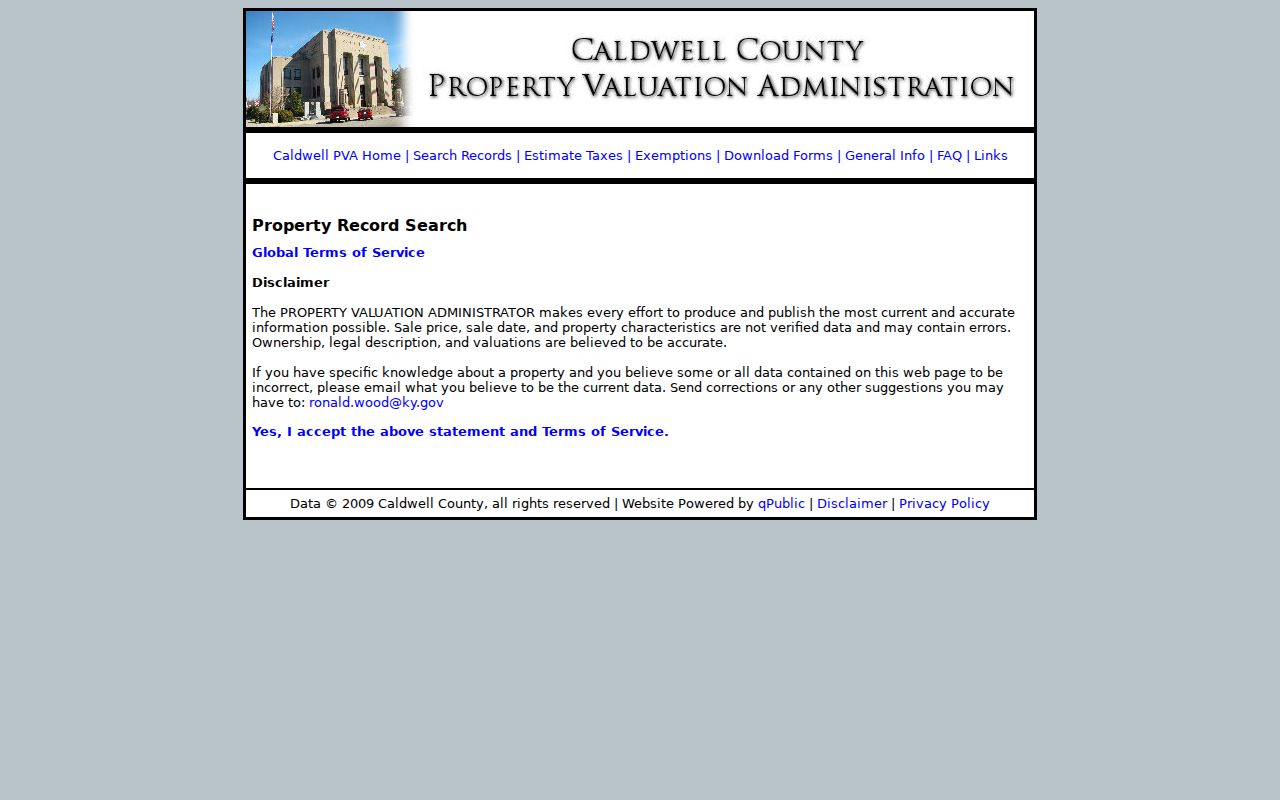
Follow the Search Records route for the live parcel card. If the SchneiderCorp page stalls or changes, call the PVA. An old screenshot is never the record itself.
Note: Preserve punctuation in map numbers exactly; short and prefix-heavy Caldwell references do not follow a publicly documented grammar.
Fair Cash Value, Class, and Tax Rates
Kentucky Department of Revenue guidance states that real property is ordinarily assessed at fair cash value. Fair cash value is the standard for assessment. Three roles stay separate here. The PVA estimates value; taxing authorities set rates; the sheriff collects. One caution on the qPublic card: the ".817" tax-rate entry is not an assessment ratio. Nobody should cite it as proof of an assessment ratio. That figure does not show a Caldwell County parcel assessed at 81.7 percent of value.
- Assessed value
- The PVA valuation carried on the assessment roll.
- Fair cash value
- Kentucky's ordinary standard for what property would bring in a fair voluntary sale.
- Levy or rate
- A rate imposed by a taxing authority and applied in the bill calculation.
- Tax lien
- A claim arising from unpaid property tax; it is not the same as a mortgage.
In August 2025, the Caldwell Fiscal Court set the rate at ten cents per $100. It applies to both real and personal property. That held steady from the prior year. Remember, the county rate is only one slice of a bill. It sits apart from the PVA's assessment and from the levies other districts add.
Caldwell Homestead and Agricultural Valuation Routes
The Caldwell PVA exemptions page explains the Kentucky homestead route for qualifying owners. These are owners who are at least 65 or totally disabled. The page also covers agricultural-use valuation. These rules touch the taxable assessment. They never touch the deed ownership itself. Applicants should work from the PVA's current instructions and forms. Eligibility and supporting documentation decide the outcome.
The local forms page gathers the homestead, agricultural, and tax-calendar materials in one place. A parcel card may flag a homestead indicator or class. But that field alone never explains why an application was accepted, denied, or changed later.
Homestead and agricultural treatment answer different questions. The local material describes the age or total-disability route for a qualifying owner. Agricultural-use rules concern eligible land instead. Read the card's class, exemption indicator, land value, improvement value, and total assessment as separate items. A lower taxable figure does not establish a sale price. Nor does an exemption entry prove that every structure or acre receives identical treatment.
When a status looks wrong, take the parcel identifier straight to the PVA. Bring any eligibility or land-use documents too. The PVA explains the roll and the application. The sheriff cannot approve an exemption just because it affects the bill. The Clerk records deeds but sets no assessments. Going to the responsible office keeps a deed recital from being mistaken for exemption approval.
Look Up a Caldwell County Tax Bill
Split the work. Use the PVA card for assessment detail, and the Caldwell County Sheriff property-tax page for the collection side. The sheriff's external bill form may not always render. Keep the parcel number handy and call the office if the online handoff fails.
- Search the PVA by address, owner, or map/account number and copy the parcel identifier.
- Open the sheriff's Search Taxes route and locate the matching bill.
- Compare owner date, tax year, bill amount and payment status with the PVA card.
- If unpaid, identify whether the account is still with the sheriff or has transferred to the County Clerk.
- Assessment roll
- The PVA's official annual property listing and values.
- Tax bill
- The collector's charge based on the certified information and applicable rates.
- Homestead exemption
- Assessment relief for a qualifying owner under Kentucky rules.
- Delinquent certificate
- An unpaid obligation transferred into the Clerk's tax-sale process.
The image below shows the linked tax-bill lookup destination captured during research.
The external form offers no stable search fields. Verify current options on the sheriff page or by phone.
Four Caldwell County Collection Windows
The sheriff publishes four collection stages. November brings a 2 percent discount, and December is face amount. January adds a 5 percent penalty. Then a 21 percent penalty applies after February 1 through April 15. Once the sheriff's collection period closes, unpaid accounts move to the County Clerk. There they handle delinquent-certificate and tax-sale administration.
| Window | Bill treatment | Office |
|---|---|---|
| November | 2% discount | Sheriff |
| December | Face amount | Sheriff |
| January | 5% penalty | Sheriff |
| Feb. 1–Apr. 15 | 21% penalty | Sheriff, before transfer |
Note: Dates and procedures can change by tax year, so confirm the current notice rather than using this timeline to calculate a payoff.
Why the January 1 Owner Can Be Outdated
The sheriff states that a Caldwell County tax bill names the owner as of January 1 of the tax year and that not every deed transfer reaches the sheriff immediately. A sale later in the year can therefore leave the former name on the bill while a newer deed already appears at the Clerk.
Recent sale check. Do not use the tax-bill name alone to identify today's owner; confirm the newest conveyance through the Caldwell County Clerk.
This timing quirk matters most when paying a bill after a closing, comparing mailing addresses, or reviewing a delinquent account. The name on a tax document reflects the roll date. It is not a continuously updated title determination.
Delinquent Certificates and Caldwell Tax Sales
The sheriff collects Caldwell County property taxes. But delinquent accounts move to the Caldwell County Clerk for the later tax-sale process. Third-party buyers should note the registration threshold. Registration applies when a purchaser buys more than three certificates in Caldwell County, or more than five statewide. It also applies above $10,000. Those rules govern how the sale itself is administered.
For any single parcel, ask the responsible office for the current certificate record. Ask for the payoff figure too. Court records become relevant only if collection turns into litigation. A delinquent tax bill alone is not a completed foreclosure. It is not a change of ownership either.
A careful review tracks the tax year, bill number, taxpayer name, principal, penalties, and payments. It also tracks the date responsibility shifted to the Clerk. Keep the stages distinct. A certificate purchase, a lien-enforcement filing, lis pendens, and a judicial sale are separate events in Caldwell County property records. A deed is separate too. Match any court case back to the parcel number and the Clerk's recorded instruments. A published notice, standing alone, never proves that title transferred. Nor does it prove that an advertised amount is the current payoff.
Contest a Caldwell County Assessment
Kentucky's property-tax calendar opens with a PVA conference and then allows an appeal to the local board. Inspect the tax roll during the statutory window. Talk with the PVA first. Gather comparable sales or property-condition evidence, then use the county-hosted 62F031 appeal form if a board appeal becomes necessary.
Appeal window. The taxpayer must complete the PVA conference step and meet Kentucky's annual calendar before appealing to the Caldwell County Local Board of Assessment Appeals; confirm that year's dates before filing.
Kentucky's assessment-process guide also covers annual revaluation and the minimum four-year physical-inspection cycle. An appeal attacks the assessment with evidence. It does not change the tax rate or rewrite a deed.
Strong evidence is tied to the valuation date. Condition photographs, measurements, corrected parcel characteristics, arm's-length comparable sales, an appraisal, or proof that the property differs from an apparent comparison all work. Start with the PVA conference. That lets the office explain its data and method. If disagreement remains, keep proof of the conference. File the current board form on time. Kentucky separates inspection, conference, local-board, and later appeal stages. A general complaint filed after the deadline may not preserve review rights.