
Compare Caldwell County's Three Value Measures
The Caldwell PVA system is where assessed value begins. A deed or parcel-card sale field adds transaction context, but neither one automatically equals what the property would likely sell for today.
| Value | What It Is | Where |
|---|---|---|
| Fair cash / assessed value | The PVA's ordinary real-property valuation | PVA assessment record |
| Taxable value | The figure affected by class, agricultural use, or exemption | PVA and tax record |
| Last sale price | Past consideration that may not be an arm's-length price | Deed and PVA sale fields |
| Land and improvements | The allocation between site and structures | Parcel report |
Kentucky ordinarily assesses real property at fair cash value. That standard covers Caldwell County parcels. Agricultural-use treatment and exemptions can lower taxable value without any change in what the property would command, and the official PVA search-information page posts the county's data caution beside its portal route.
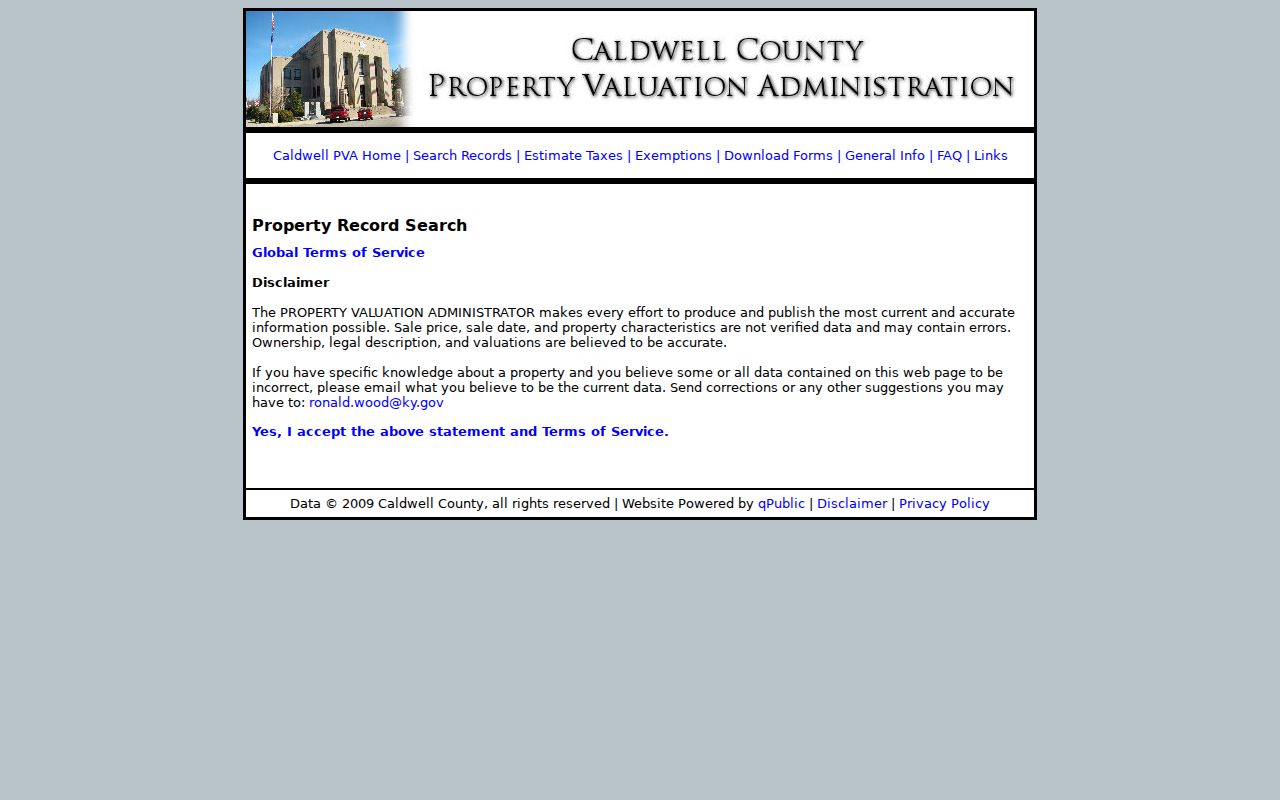
That screen is an access point, not an appraisal. Open the live parcel record to read the current valuation year and its fields.
Locate a Caldwell County Value Snapshot
Treat every value as year-specific. A sample PVA record's upload timestamp shows exactly why a freshness date belongs beside the dollar figure.
- Search the address or map number through PVA/Beacon and verify the situs.
- Record the year, land, improvements, total, class, homestead indicator, and upload time.
- Read sale date and price with the PVA disclaimer, then inspect the matching deed.
- For a challenge, assemble qualified comparable sales and contact the PVA before deadlines.
- Assessed value
- The PVA's value of record under Kentucky rules.
- Fair cash value
- The estimated price in a fair voluntary sale.
- Taxable value
- The amount after relevant class or exemption treatment.
Read Caldwell Land, Improvements, Class, and Exemption Together
A parcel report can expose map and account numbers, tax district, class, and homestead status. It can also show tax rate, deed reference, sale fields, and upload time. Land and improvement components explain how the value is allocated. Class flags ordinary or agricultural treatment, while an exemption shrinks the taxable base. Eligibility and valuation are separate questions. A lower taxable amount does not mean reduced market appeal. The PVA's forms and exemptions resources supply the local route for homestead, disability, and agricultural-use questions. Keep the valuation year attached whenever figures are compared.
Do Not Turn the Sample .817 Rate Into a Ratio
A sample record displays a .817 tax rate. That number feeds the tax calculation. It is not evidence that Caldwell property is assessed at 81.7 percent of market value. Kentucky's ordinary standard is fair cash value. The separately reported 2025 county rate of 10 cents per $100 was likewise a levy choice rather than a parcel valuation. Multiple districts and years produce different tax calculations. Use the Kentucky Department of Revenue assessment guidance to interpret value, and check the Sheriff record for the bill itself.
Test a Caldwell Sale Price Before Comparing It
Not every number in a deed reflects the open market. The PVA warns that sale data can be incomplete or wrong. Some conveyances are not arm's-length deals at all. Family transfers, estate distributions, quitclaims, partial interests, commissioner deeds, and sheriff deeds all carry figures. Those figures say little about what a parcel would fetch from a typical buyer.
Before trusting a sale price, compare the date, the parties, the deed type, the legal description, and the consideration through the Caldwell Clerk records route. The public 310 Hawthorne example ties an address to map P10-3-14 and deed 108/24. It shows how to verify a property across systems. That check is not about what the property is worth today.
Account for Annual Revaluation and Four-Year Inspection
Kentucky calls for annual revaluation. Every parcel also receives a physical inspection at least once every four years. Value can shift after inspection, market analysis, construction, demolition, parcel division, classification changes, or corrected facts. Always record the year and the upload date. If the characteristics look wrong, contact the PVA. The public-search disclaimer routes corrections back to the office with the parcel number and evidence in hand.
Support a Caldwell Assessment Challenge With Evidence
The Kentucky property-tax calendar lays out the inspection, conference, local-board appeal, and evidence sequence. Caldwell hosts Form 62F031 for that appeal. It goes to the Local Board of Assessment Appeals. Evidence can include qualified comparable sales, photographs, condition facts, measurements, or an appraisal tied to the valuation date. Bill payment belongs with the Sheriff. Valuation evidence belongs with the PVA and the appeal process, so verify the current year's dates before filing.
Explain Why Exemptions Change Taxable Value
Caldwell's PVA materials cover homestead treatment for qualifying age or disability, along with agricultural-use valuation. These rules can lower the taxable figure. They do not touch a deed's sale consideration or the other displayed measures, and they should not be used to infer what the whole property would command in an open sale. Check the class and exemption fields before comparing two parcels. A residence without the same exemption, a farm under agricultural valuation, and a commercial parcel are not interchangeable just because their acreage or neighborhood appears similar. Ask the PVA which field and valuation basis apply. Don't reverse-engineer eligibility from a number.
Compare Caldwell Sales on Matching Terms
A comparison only works when the terms match. Anchor every sale to the same valuation date, property type, and rough location. Land use and physical features should line up too. The transaction must also be qualified, meaning an ordinary sale. Note the source deed and parcel number for each comparable. That way anyone can check the sale later. Pull aside transfers involving estates, relatives, or partial interests. The same goes for foreclosure and commissioner or sheriff action. Label them separately or leave them out.
The PVA applies several recognized appraisal approaches inside a mass-assessment program. So do not assume a displayed total traces to the nearest recent sale. When a comparison stays murky, ask the office for the parcel facts. Ask also for the valuation explanation behind the number.
Timing matters as well. Construction or demolition between assessment and sale can leave two dates describing materially different property. Rehabilitation does the same. Watch for parcel division, acreage correction, or a class change. Compare building description, land area, class, and improvements on dated records. If a correction or upload followed the sale, keep both dates.
Homestead treatment and agricultural-use valuation sit apart from physical similarity. Two neighboring parcels of equal acreage can carry different taxable figures because only one qualifies. Before drawing a contrast, give each record its own columns. List the fair-cash assessment, exemption code or amount, agricultural class, and resulting taxable value. That keeps the comparison honest.
Know which office answers which question. The Sheriff bill supplies timing and payment status, never a second appraisal. Its January 1 owner rule can leave an earlier name on the bill. That name may linger after a sale. Discounts and penalties change the amount due without touching assessed property value. Use the bill for tax year, district, and collection status. Use the PVA for valuation. Use the Clerk deed for the transaction itself.
Build appeal evidence around the statutory process. Identify the subject parcel and the tax year. List each comparable with its parcel and deed references. Explain the physical differences. Keep photographs or measurements on hand. Kentucky's calendar runs from inspection and taxpayer conference to local-board review. Dates shift, so verify them each year. A bare appeal form without property-specific evidence proves little. It does not show an assessment exceeds fair cash value.
Reach the Caldwell PVA Beyond the Web
Portals are not the only way in. The county directory identifies PVA Ronald Wood. It also gives the office route. qPublic pages publish forms, office information, and correction guidance even when the current Beacon search encounters Cloudflare. Calling or visiting? Bring the map number, situs, owner spelling, and valuation year.
Kentucky's Open Records Act covers formal requests for an existing record. Submit them signed by hand, mail, fax, or email. Exemptions and copy procedures apply. Ask for the parcel assessment or a specified supporting record. The custodian cannot produce a private appraisal or predict a selling price.
Historic and unusual properties demand careful feature matching. A landmark, older storefront, or rural farm improvement can carry attributes that ordinary nearby sales never share. So can a vacant government parcel. Use historic material to verify age, configuration, and prior use. Then test those facts against the current PVA description. Historic designation, cemetery proximity, or a public notice does not translate directly into a dollar adjustment. Tie any adjustment to the valuation record or a qualified appraisal. The historical source explains context. It creates no automatic premium or discount. Keep every adjustment anchored to dated, parcel-specific evidence.
Understand the Limits of Caldwell Assessor Value
Every PVA value comes from a countywide assessment process. That process can lag changes in condition or demand. It is not a promise of sale proceeds. One recent qualified sale can inform a comparison, yet a single transaction cannot establish the value of every nearby parcel. For an opinion tied to a specific transaction, hire a Kentucky-licensed appraiser and give that appraiser the subject property's current facts.
Value versus price. A Caldwell County assessment, tax rate, or old deed price is not a current appraisal, sale guarantee, survey, or title opinion.